

Check this out:
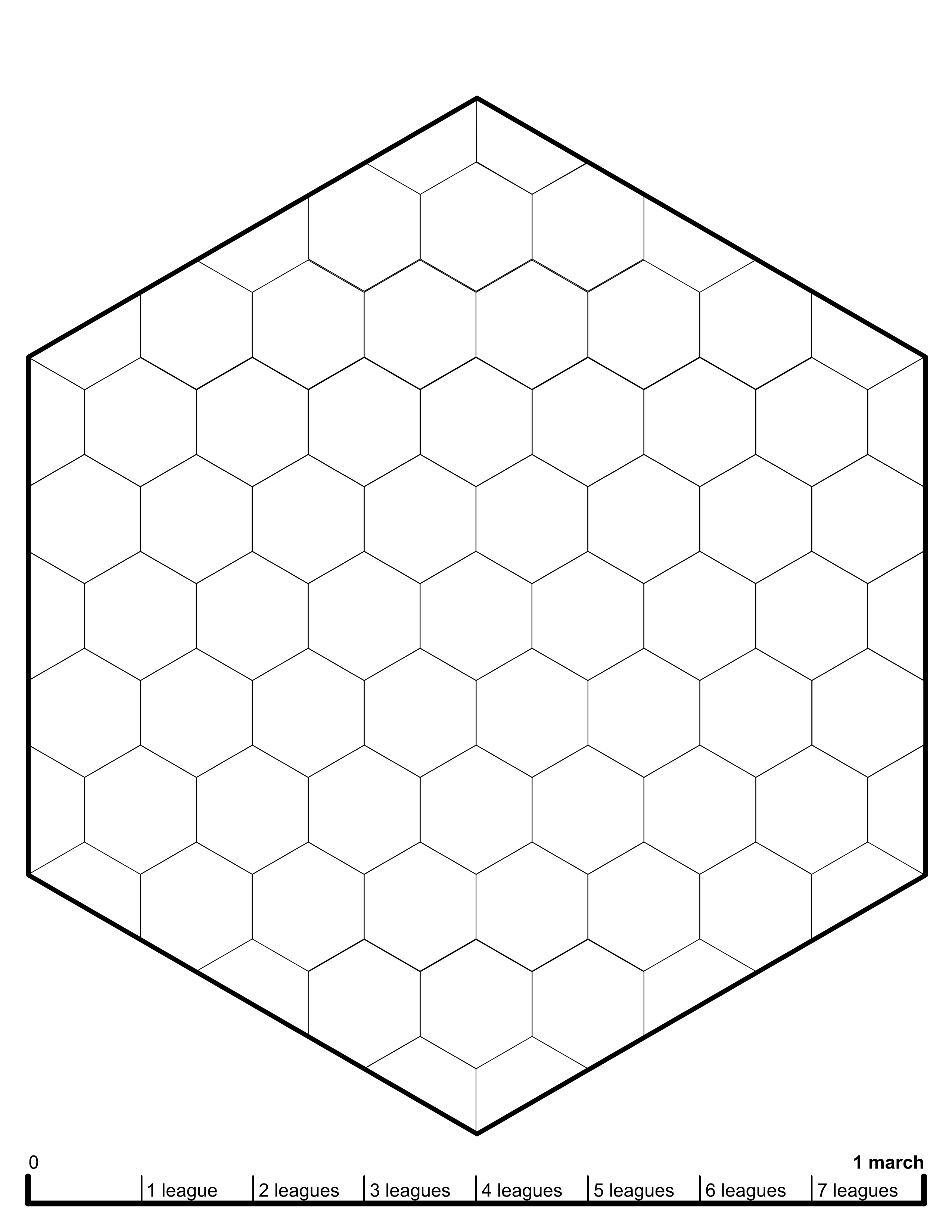
This is a 24-mile hex. In the world of Materia Mundi, the Old Empire called this a “march”, because it was the distance their army could march in one day along an open road. You will note that it is separated into 3-mile sub-hexes, called “leagues”.
Now, let’s look at a league hex in detail:
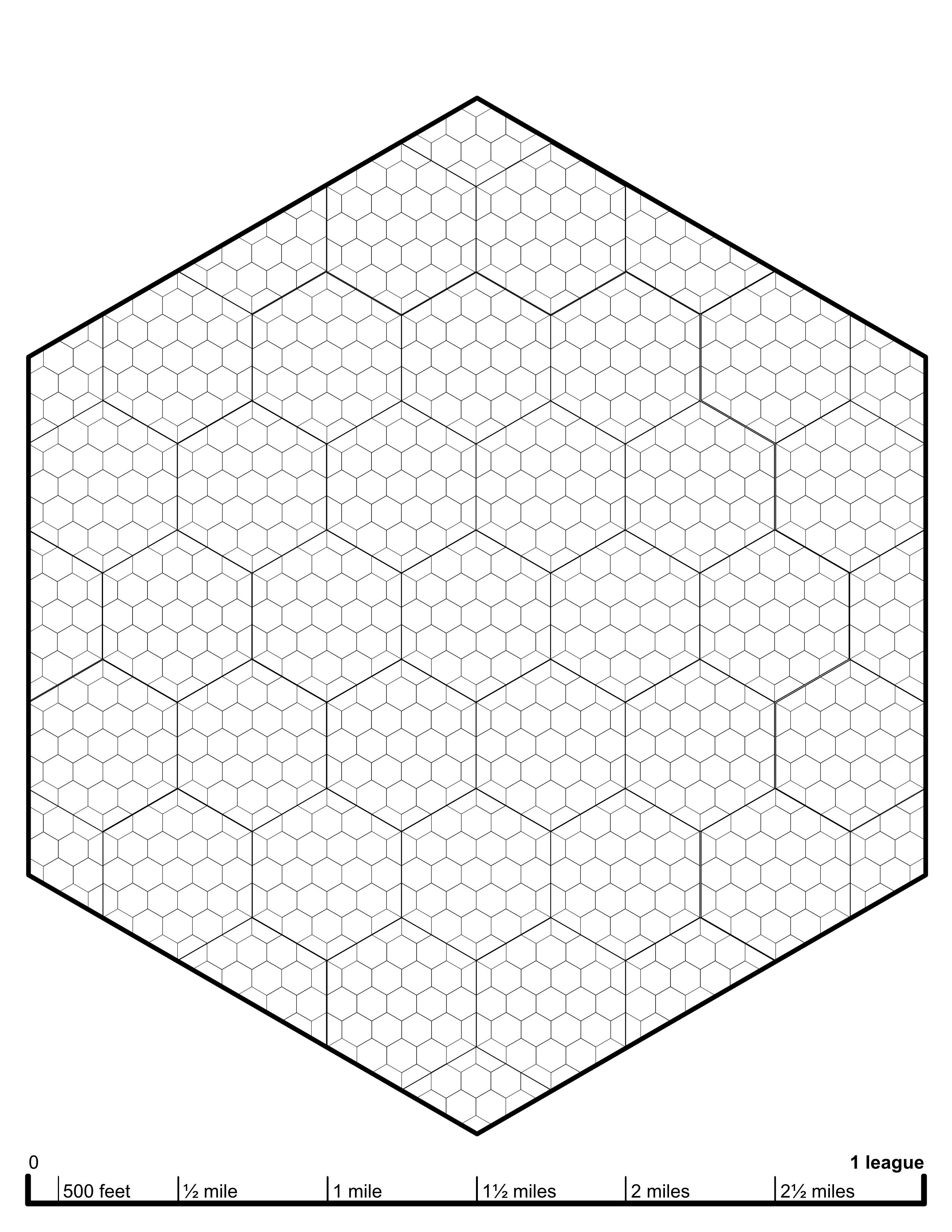
While a march subdivides into eight leagues, a league subdivides into six half-mile fields. Using half-mile ‘field’ hexes lets you run travel and exploration on the same time scale (10 minutes per exploration turn). Each field hex is also split into five smaller ‘furlong’ sub-hexes, each of which is 500 feet in diameter.
During a single exploration turn, the party can choose one of the following movement:
Travel across five furlongs of open terrain
Travel across three furlongs of complex terrain
Dash across twenty furlongs of open terrain (ten if encumbered); every exploration turn past the first spent running requires a save vs. Doom to avoid suffering 1d6 damage from fatigue.
Note that these travel speeds - five furlong hexes walking across open terrain, three walking across complex terrain, or twenty/ten dashing - are identical to encounter movement speeds. Essentially, when using furlong-sized hexes and 10-minute exploration rounds, you can use encounter movement speeds straightforwardly.
If the party chooses to stay in their current hex, they can explore or interact with it:
Explore one furlong of open terrain (easy Survival or Alertness check)
Explore one furlong of complex terrain (hard Survival or Alertness check)
Interact with a terrain feature within a furlong hex (per referee judgment)
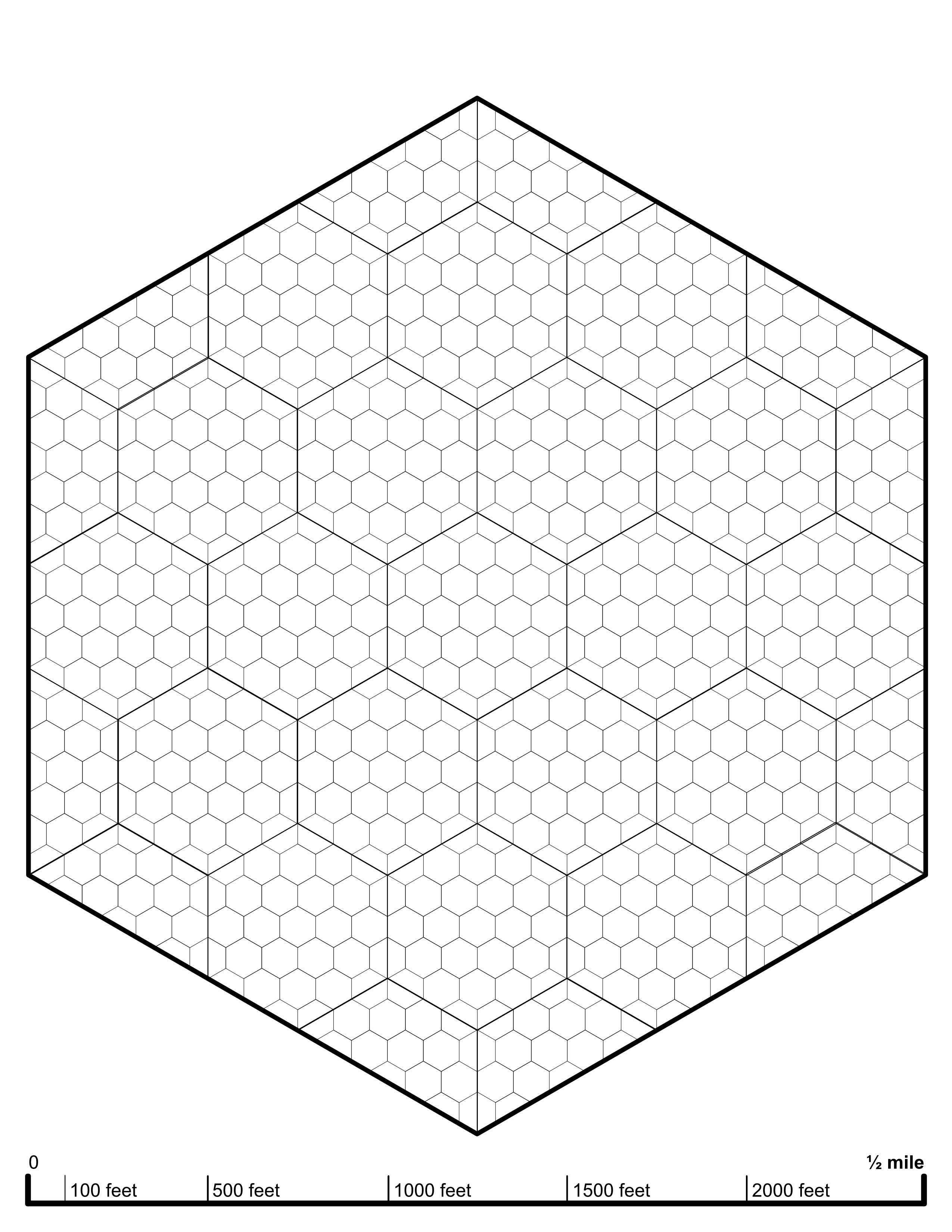
Continuing to zoom in, we see a field hex here, subdivided into 500-foot furlongs. Each furlong is further subdivided into 100-foot ‘plethrons’. This specific measurement system - marches, leagues, miles, fields, furlongs, and plethrons - is consistent across the entirety of Materia Mundi’s Successor Kingdoms, who inherited it from the survey measurements of the Old Empire. One thing to note is that these distance terms are not quite identical to their modern English Imperial equivalents. For example, a ‘mile’ is precisely 5000 feet, rather than the English mile’s 5280 feet; a ‘furlong’ is a tenth of a 5000ft mile (500 feet), rather than an eighth of a 5280ft mile (660 feet).
Below 100 feet, it stops making sense to subdivide into hexes; the next step down should be an ‘encounter map’, divided into a square grid of 5-foot paces. But even the 100 foot hex-map can be useful for encounters, especially for ‘mass battles’. Here’s how Materia Mundi handles mass battles on the hex-map:
A single combat round is 6 seconds, as normal.
A creature on foot can dash from one plethron-hex to another, or stay in its current hex and attack. Cavalry can move and attack in the same round, as can anything else (such as golem armor) with a 100’ or better base movement speed.
Moving through complex or difficult terrain requires a save vs. Hold to avoid getting bogged down and stuck in the current hex.
Creatures within the same hex can engage or disengage from each other; once engaged, they are stuck in melee until they successfully disengage.
The 100-foot hexmap is really ideal for golem armor combat (hint: 100 feet is roughly 30 meters, the exact size of hexes in everyone’s favorite giant stompy robot wargame Battletech. This means that you can just go ahead and borrow your Battletech maps to run all your Materia Mundi / E9 outdoor battles. You’re welcome.)
Is subhexing officially back? I've seen a few people talking about this recently.
Honestly I've never understood hexes and sub hexes.
What I do is I have freeform regions of a single environment (e.g. forest) and inside those I have locations and some variations in the environment, I use a ruler to determine how far things are to see how people travel.
To me it looks both simpler and less abstracted than hexes especially when sun hedging comes into play.
All of this to say I don't understand what the deal with hexes is and maybe you can explain why you find hexes better than a ruler method.